
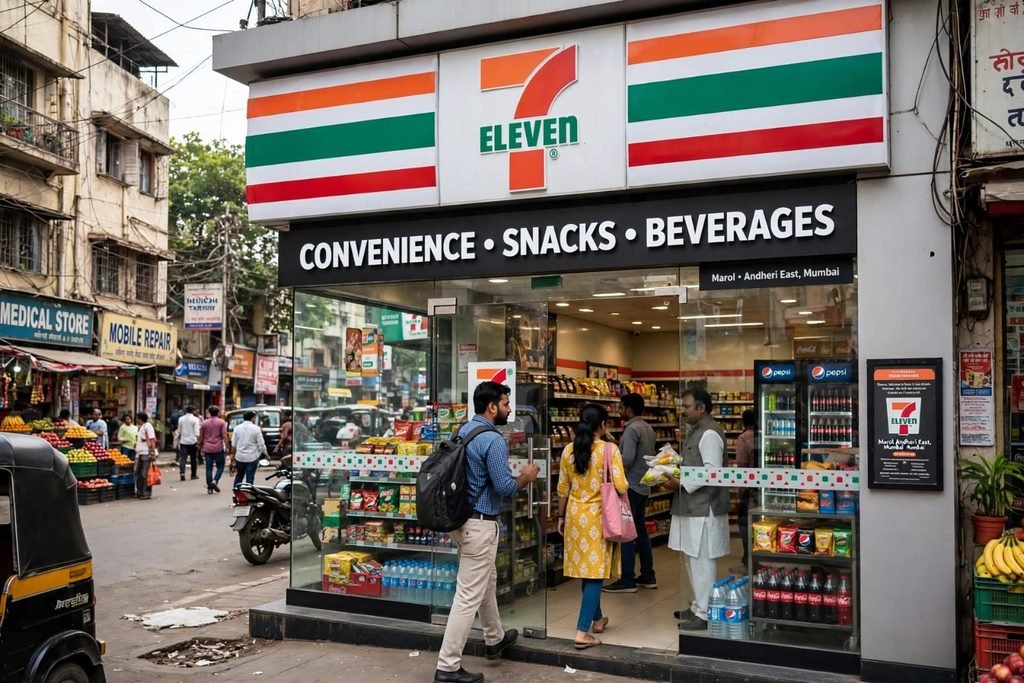
What happens when a global convenience store chain enters the land of kirana stores and street food vendors? It shuts down within five years.
If you have visited Japan, Thailand, South Korea or the US, chances are you have stepped into a 7-Eleven, the ubiquitous convenience store found in neighbourhoods across these markets. Founded in the US, 7-Eleven is headquartered in Irving, Texas and owned by Japan’s Seven & i Holdings Co., a retail conglomerate based in Tokyo. Its name dates back to the chain’s original US operating hours: 7 am to 11 pm.
The global convenience store chain first attempted to enter India in February 2019 through a master franchise agreement with Future Retail. That venture never took off, and the agreement was mutually terminated in October 2021. Within the same month, 7-Eleven signed a new master franchise agreement with Reliance Retail Ventures (RRVL) and opened its first Indian store in Andheri, Mumbai.
The proposition was to sell snacks, beverages, fresh food, daily essentials and international 7-eleven products adapted to Indian tastes.
“The 7-Eleven brand’s entry into the country will modernise the small-retail environment and bring greater convenience to shoppers” read the press release issued by 7-Eleven Inc. on the opening of first store by 7-India Convenience Retail, a wholly-owned subsidiary of RRVL. “7-Eleven will support RRVL to implement and localise its unique retail business model.” India became the 18th country in which 7-Eleven operated stores.
At its peak, the brand operated 60 stores across Mumbai and Pune by the end of 2025. But mounting losses led to a scale-down this year, and the remaining 31 stores closed on September 30, 2026.
What does the closure of 7-Eleven Stores in India mean?
- Local Kirana stores operate on unit economics that are difficult to beat
7-Eleven’s exit highlights the challenge of establishing a profitable convenience-store format in a market that has deeply entrenched and resilient informal retail infrastructure; as well as the growing adoption of technology-driven retail formats.
In many developed countries, modern convenience stores fill a clear gap in the consumer retail market. In India, the neighbourhood kirana store, often with a food counter outside, already fills much of that need.
Kirana stores operate on a low-cost, high-resilience model that can make profitability possible even with an average order value of Rs 100-200. Many occupy 100 to 500 square feet and operate out of owned, family-run or low-rent residential properties, keeping real estate costs low. Family members often manage day-to-day operations, reducing the wage bill that organised retail formats and quick commerce businesses have to contend with. Their inventory typically focuses on high-turnover, daily-use essentials, while gross margins vary by product category and business model.
Despite their reach and lean operations, the kirana stores are facing disruption from tech-driven quick commerce platforms.
Quick-commerce platforms have raised the bar for convenience by bringing a wide assortment of products to consumers’ doorsteps, often within minutes. They are competing with kirana stores on immediacy and availability, even as they grapple with the economics of fulfilment, delivery and customer acquisition.
In such a hyper-competitive market, it becomes difficult for a global convenience store chain to find its niche and profitably capture frequent, low-value purchases.
A large consumer market does not necessarily become an attractive market for every retail format.
- Deep pockets cannot compensate for weak unit economics
Deep pockets can finance losses, they cannot automatically fix unit economics. A company with substantial financial resources can afford to lose money while building a business. But if every additional store adds costs faster than it adds to the business’s overall profitability, expansion can make the total loss larger rather than smaller.
The financial trajectory of 7-India Convenience Retail shows how the business tested the financial patience of its parent companies:
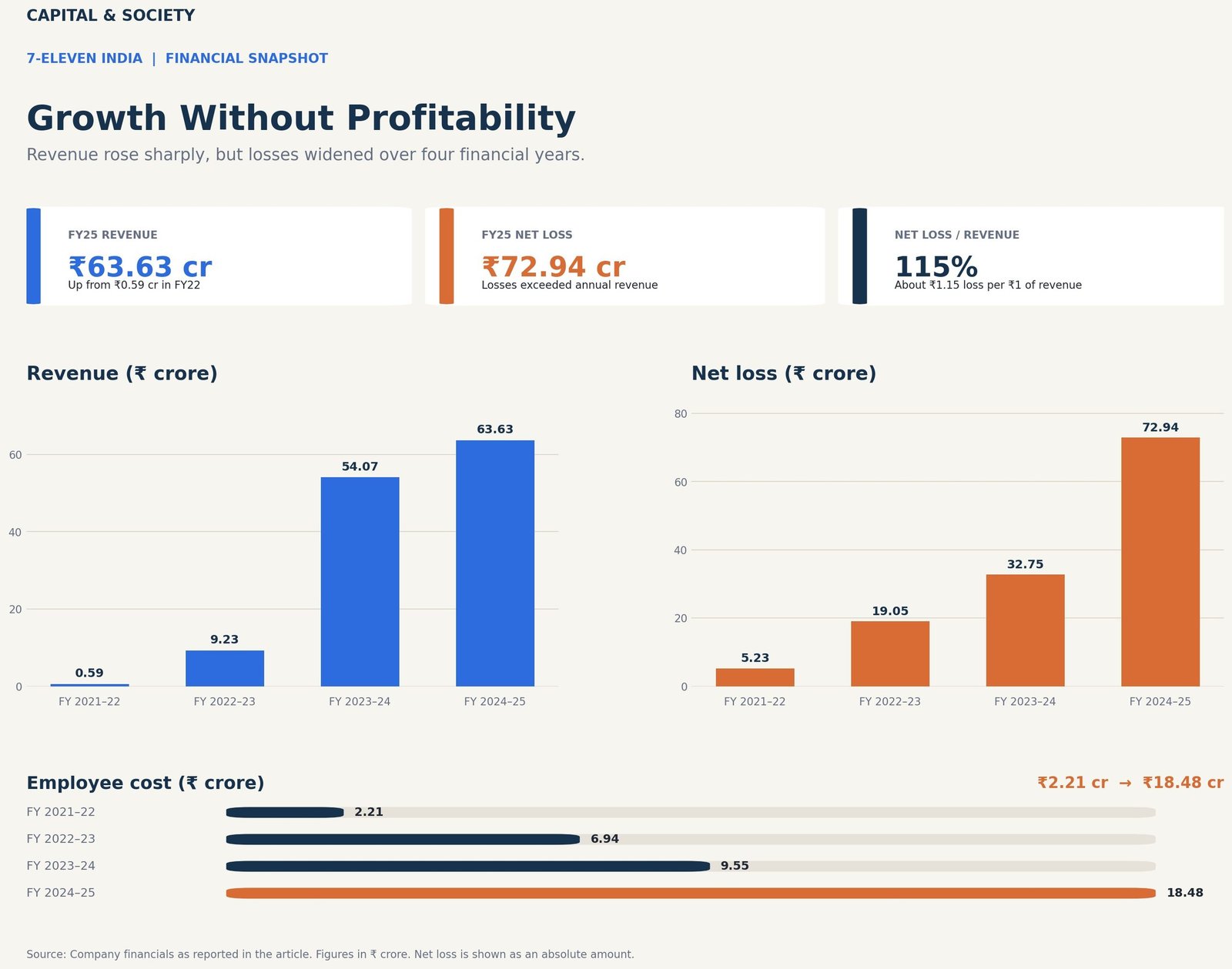
From a net loss of over Rs 5 crore in FY22, the loss ballooned to nearly Rs 73 crore by FY25, even as revenue rose from just Rs 59 lakhs to over Rs 63 crore. Revenue growth effectively did not translate into a viable bottomline. The widening gap between revenue and losses raises questions about whether the business could generate sufficient sales at each store to cover its costs.
Subscribe to read further!