
On June 23, 2026, India cheered the news of Mumbaikar Kunal Shah being appointed as the global head of WhatsApp. In the same week, international banker Ashok Vaswani announced his decision to step down as CEO of Kotak Mahindra Bank by the end of the year, choosing not to seek re-appointment upon completion of his current three-year term. The two developments could not have been more contrasting.
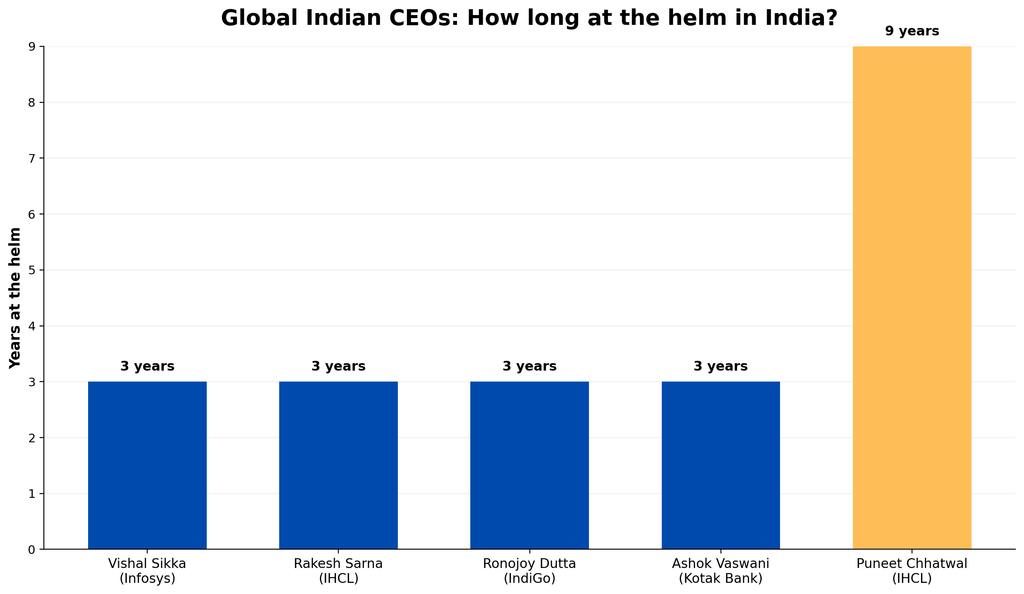
At a time when executives of Indian origin are regularly becoming CEOs of global companies, Indian-origin executives who have built global careers and then come back to helm Indian companies generally tend not to last much beyond three years. In fact, the three-year mark appears to be a recurring point of departure for Indian-origin executives returning from global careers to lead Indian companies. Ashok Vaswani’s term at Kotak Mahindra Bank, Vishal Sikka’s term with Infosys, Rakesh Sarna’s tenure at Tata group-owned Indian Hotels Company (IHCL) and Ronojoy Dutta’s stint with InterGlobe Aviation (IndiGo) are four cases in point.
Silicon Valley executive Vishal Sikka served as the CEO of Infosys from June 2014 until his high-profile resignation in August 2017 following a bitter rift with a section of the company’s founder-shareholders led by Narayana Murthy.
Global hospitality industry veteran Rakesh Sarna was appointed as the MD and CEO of IHCL in September 2014 but stepped down upon completion of his three-year tenure. Sarna was one of the appointees made by former Tata Sons Chairman Cyrus Mistry and, after the latter was ousted from his position in Tata Sons, Sarna’s departure had seemed imminent. Before joining IHCL, Sarna had spent more than three decades at American hospitality major Hyatt Hotels Corporation.
Global aviation industry veteran Ronojoy Dutta was appointed as the CEO of IndiGo in 2019. However, he sought an early retirement in September 2022, stepping down around 17 months before his five-year tenure was to end in January 2024. During his tenure, he oversaw the company’s operations during the tough Covid-19 pandemic and an ugly spat between founder Rahul Bhatia and co-founder Rakesh Gangwal.
However, one global Indian CEO has broken the pattern and built a long tenure at an Indian company. He is Puneet Chhatwal, an executive leader from the European hospitality industry, who has been successfully helming IHCL for nearly nine years. Roped in as a successor to Rakesh Sarna in November 2017, Chhatwal had initially turned down the role in 2013. In an interview last year, he emphasised that working for the Tata group carries a unique weight: ‘When you serve the Taj, you serve the nation’. He has viewed his role not just as managing a commercial hotel chain, but as a custodian of an institution aligned with the Tata ethos of community impact and livelihood creation.
In fact, the Tata group stands out among Indian business houses for having hired a significant number of expats to head its businesses as part of its efforts to internationalise the conglomerate.
Nevertheless, very few successful Indian-origin executives heading global companies do end up coming back to head Indian companies. Most global Indians who come back prefer to take the entrepreneurial route or to helm the India operations of the multinational they have been working with. For instance, Anand Deshpande gave up a lucrative career track in the US to set up Persistent Systems. Sanjiv Mehta and Suresh Narayanan came back to India to head Hindustan Unilever and Nestle India respectively.
For that matter, it is not just the C-suite. Indian companies have very few global desi executives on their boards too.
Subscribe to read further!