
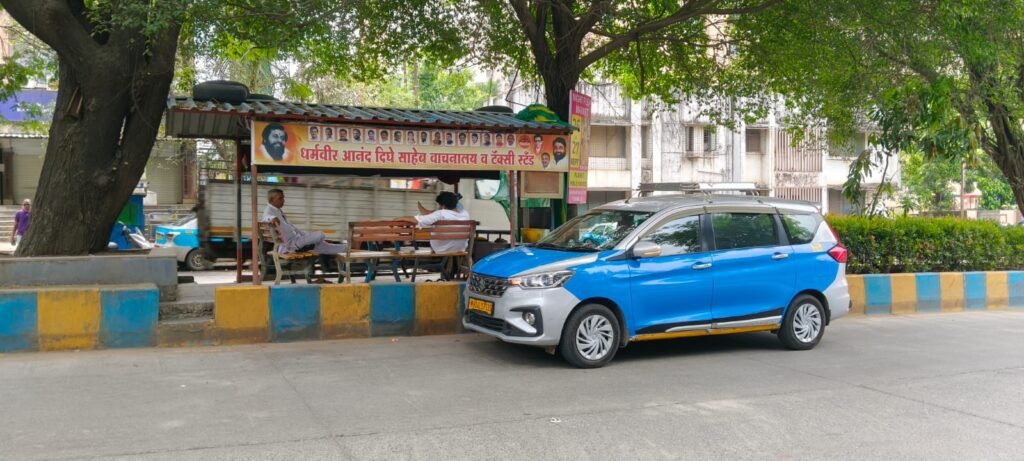
Photo : Bharat Bagwe
“I wonder how long we will be able to continue this community taxi service”, said Sher Singh Choudhary, Chairman of the Dharmaveer Anand Dighe Taxi Stand located outside Hiranandani Estate, a sprawling township in Thane, a city adjacent to Mumbai. Around 20 taxi drivers currently operate from Hiranandani Estate, providing on-call taxi service to the residents. However, their business has been dwindling, amid competition from lower-priced ride-hailing platforms and rising operational challenges.
A few taxi drivers hailing from Himachal Pradesh started the taxi service in 2012 with help from a local politician in setting up the mandatory taxi stand. Their fleet comprises Cool Cabs, a government-regulated category of metered air conditioned taxis that command a premium over regular taxis and have a distinct blue-and-grey colour scheme in Maharashtra.
“They were twice refused by my office”, said Mahendra Madhvi, a local Shiv Sena politician. “However they remained persistent and considering their noble cause of providing a reliable taxi service to the surrounding community, I and my wife Bindu Madhvi, helped the drivers liaise with the local regional transport office as well as municipal corporation to set up the taxi stand for them”, he said.
Initially, 80-85 such taxis were deployed to exclusively cater to the residents living in and around Hiranandani Estate. Eventually, the number came down to around 50 taxis, with each driver earning an average of around Rs 2,000-2500 (net of expenses) daily from 3 to 4 rides before the pandemic. The residents call the taxi stand number to book a taxi and the rides are allotted to each driver on a turn-by-turn basis. Local political support has helped navigate local transport and municipal regulations. The presence of a physical taxi stand, however rudimentary, has helped consolidate their existence as a community service. Given the relatively small close-knit group of drivers, it has been possible to provide prompt and reliable service. Most drivers reside nearby and have made arrangements to park their taxis in close proximity to the stand. If there are no taxis at the stand when a customer calls, the coordinator attempts to arrange one from outside the network, ensuring that the customer is served rather than prompted to turn to a ride-hailing app. In fact, the captive customer base residing in the gated community has been a key incentive to keep the taxi-service going.
Over the years, the Hiranandani Estate township grew significantly, adding more residential as well as commercial buildings, but the number of taxis at the taxi stand kept reducing. Today, the stand has around 15-20 taxis, holding out against competition from on-demand ride-hailing technology platforms such as Uber, Ola and Rapido as well as app-based shared mobility platforms like Cityflo and Chalo bus. For instance, a Cool Cab ride from Hiranandani Estate to the airport typically costs Rs 900. However, an Uber or Ola booking for the same route on a regular day may cost the customer around Rs 500. Consequently, on a normal day, the taxi service driver ends up making Rs 500-1000 (net of expenses) from a couple of rides. The taxi stand gets around 15 calls every day. However, not all calls translate into rides. At times, the callers compare the fares quoted with what they get on the ride-hailing apps and choose not to book a ride with the taxi stand.
According to Choudhary, around 80% of the calls come from customers who have had a frustrating experience with ride-hailing apps and are seeking a more reliable service. The rides booked by the apps can be fraught with issues such as poor availability, drivers cancelling, surge pricing or inconsistent service. In contrast, the driver assigned by the taxi stand service calls the customer 15 minutes before the scheduled time of the ride.
“It’s not just low-priced competition, there are operational issues too”, pointed out Choudhary. The rising fuel prices and maintenance costs, the continuous struggle in exerting discipline and loyalty from the drivers in the group as well as the slow, limited effect of word-of-mouth publicity end up being headwinds. For instance, the proposed requirement in Maharashtra for auto and taxi drivers to demonstrate working knowledge of Marathi could pose yet another operational hiccup.
“Drivers jumping the queue or appropriating someone else’s ride have to face disciplinary action”, informs Choudhary. “A three-day ban from the group is the immediate punishment for defaulting drivers. If the misdemeanor repeats, the ban is extended to six days”, he said. All complaints are redressed by the office bearers, who enforce the disciplinary action according to the gravity of the complaint. According to Choudhary, the local political backing also helps enforce discipline among the drivers.
The working of the community taxi service is quite different from that of ride-hailing platforms. The latter have a clear advantage in technology, geographic reach and on-demand availability.
The moot question is: does a community taxi service still stand a chance of survival?
Subscribe now to read further!
Thanks for insights.
I am looking curiously at Bharat Taxi ,a cooperative venture.
Hope for the best.
Firstly, congratulations on writing this, Kiran. Just one point—forget technology platforms or other advantages: my question is whether these community taxi owners/drivers invest even a little in keeping their taxis clean and trying to stand out? They could be extra polite and gain loyal customers? More importantly, prioritising passenger safety—through well-maintained vehicles, visible driver identification, and safe driving habits—is absolutely critical to building trust. There are a lot of small, zero-cost ways to gain the confidence of customers and survive; safety and basic hygiene are the bare minimum needed to stay competitive.