
“I end up walking over 24,000 steps daily,” says 41-year-old Manoranjan, who walks dogs in his neighbourhood at Uber Verdant, Bengaluru. Originally from Odisha, Manoranjan works for a hotelier living in the residential complex. What started as walking his employer’s dog because of his love for pets has turned him into an accidental dog walker in the locality. For the past two years, he has been walking two to three dogs in the morning and evening, earning Rs 3,000-4,000 per dog each month.
He is not alone. 19-year-old Muthuraj quit his studies in Bijapur and moved to Bengaluru to support his family. He earns around Rs 25,000 a month by walking dogs daily for three to four households. He works from 6 am to 8 am and then again from 3 pm to 6 pm. He is able to save around Rs 17,000 a month, which helps run the household and fund his sister’s marriage.
Ajay Patil, a full-time professional dog walker from Thane, walks around 15-16 dogs daily, earning around Rs 6000 per dog a month. He starts his day at 5 am, walks the dogs till noon and then walks again from 2:30 pm to 11 pm. Each dog gets to walk for around half an hour in the neighbourhood. Ajay has also taken anti-rabies vaccination to protect himself against the risk of infection.
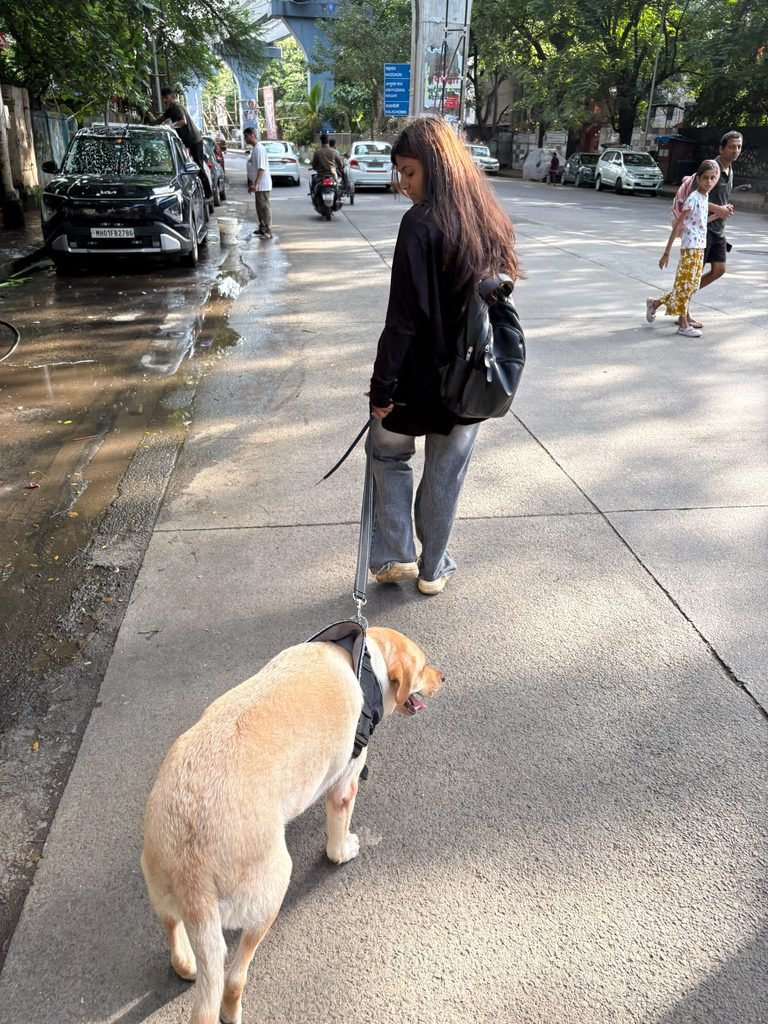
A new category of workers is slowly emerging in India’s urban service economy. Increasingly visible in residential neighbourhoods across cities, they are turning dog walking into a source of livelihood. They come from different backgrounds, ranging from domestic helpers, drivers, watchmen and nannies to college students and youths between jobs. For domestic helpers, dog walking can become a win-win arrangement, allowing them to earn a little extra by working in the same household.
Some entrepreneurs are now looking to organise these disparate informal workers, seeking to build an Urban Company or Snabbit-like model for pets and pet parents.
Gurugram-based Sploot is among the leading players offering integrated, on-demand pet services such as grooming, dog-walking and meals. Set up in 2019, it operates in several tier 1 and 2 cities. Regional players are also emerging to address hyperlocal demand.
“Our customers prefer female dog walkers over male walkers”, said Essai Surya Thevar, co-founder of Paws and Pots, a company providing care services for plants and pets. It operates dog-walking services in the micromarkets of Mumbai, Chennai and Bengaluru.
Among its 65 walkers in Mumbai, around 35 are women, predominantly domestic helpers who double up as part-time dog walkers. Paws and Pots has around 25 walkers in Chennai and 20 in Bengaluru. The business receives around 45 bookings a day through calls and WhatsApp. The walkers are paid a monthly salary, and around half of them are permanent staff with insurance coverage.
The new-age dog-walking startups connect pet parents with background-verified individuals who offer live GPS tracking, structured exercise routines and photo or video updates. Their walkers are professionally trained, wear branded uniforms and carry poop bags.
“For us, every walk is a responsibility, not just a service”, said Saran Thevar, co-founder and COO of Paws and Pots. “We aren’t just walking dogs; we are becoming a part of their family. It’s about building trust, understanding their behaviour, ensuring their safety, and giving every pet due care and attention.”
But building a recurring business around dog walking is not easy.
“80-90% of pet parents walk their dogs themselves,” says Mihir Shah, co-founder of Woof n Goof, a pet care service in Thane. “Once in a while, they need someone to walk their dog for around two to three days in a month or take the dog for a follow-up visit to the vet. In such a scenario, a business model built around monthly subscriptions is difficult to crack.”
Mihir has soft-launched Sniff-it, an offline service providing on-demand dog walkers which is being tested in select micromarkets of Thane. The final launch, tentatively scheduled for January 2027, will depend on business traction, investor interest and revenue generated.
“Just demand-side aggregation is not enough. Supply-side aggregation is also required for smooth functioning of the gig platform. Existing local dog walkers do not want a middleman to come between the pet owner and dog owner”.
Mihir’s strategy is to bring existing dog walkers onto his platform as gig workers. It takes effort to build trust and convince the dog walkers about the benefits of being on the platform.
The startups provide subscription-based and on-demand bookings for pet owners. Pricing varies according to the service provider, customer requirements and the micromarket being serviced. Paws and Pots charges a standard rate of Rs 99 per hour. Wagify charges between Rs 130 and Rs 180 per hour, while Woof n Goof’s rates start at Rs 75 per hour and can rise to Rs 350 on weekends.
Customers are willing to pay these rates as there are concerns about the quality and reliability of the service being provided by informal dog walkers.
“Instead of actively walking the dogs, some dog walkers tend to loiter around with the dog while speaking on the phone. Some even hit or abuse the dog in a bid to discipline them” says the co-founder of Wagify, a dog-walking service operating in the micromarkets of Ghatkopar and Kurla in Mumbai.
The co-founder, who prefers to remain anonymous as the company is being built in a stealth mode, says the startup has employed seven to eight dog walkers on a salary-plus-incentives model. They are typically men aged 21-35, who also take up handyman jobs or work on quick-commerce platforms. They are expected to work for Wagify in the morning, from around 5 am to 9 am, and again in the evening, from 5 pm to 9 pm. Outside these shifts, they are free to take up other work. “Our walkers know how to manage the leash and handle different types of dogs”, says the co-founder, who intends to launch an app and eventually become a tech-first company.
“I like to walk my pets as the walkers generally are a careless lot”, said Amit Chandra, a retired army officer. “They take the dog outside but are often found busy chatting on the phone or loitering around. However, he was particularly impressed with Ansh, a college student pursuing a BSc college degree, whom Mihir had referred to as a dog sitter and walker. Ansh was dependable, loved my dog, fed it and took good care of it while Amit was away. Ansh charged Rs 450 per day for his services.
How is an activity once performed by household staff, domestic workers or pet owners becoming a specialised paid service?
Subscribe now to read further!