
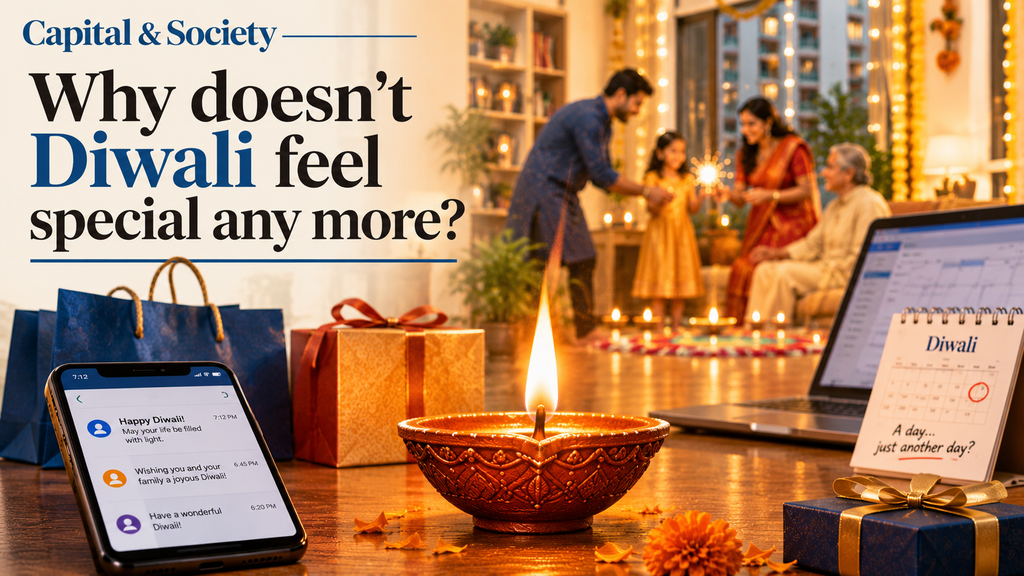
Widely considered India’s biggest and most important festival, Diwali does not feel as special any more. The festival of lights symbolises the victory of good over evil – a message that resonates across communities in the country. Spanning five days, it brings families together to celebrate with food, rituals, traditions and gifts.
However, with each passing year, the festival seems to be losing some of its old-world charm and fervour. In fact, Diwali is not necessarily becoming less important; rather, the social and economic conditions that once made it feel special are changing the way people experience it.
Here are five main reasons why Diwali feels far less special to those who have been celebrating it over the past few decades:
1. Year-round Consumption
In a rapidly growing consumption-driven economy, ubiquitous consumption has become the default – particularly among urban consumers with greater disposable income and access to credit. The trend towards premiumisation, the availability of easy credit and the emergence of several alternatives in terms of local and global brands have further facilitated consumption that is time or context agnostic. From occasion-driven consumption, people have moved to year-round consumption driven by desire, convenience and mood. Consequently, occasion-driven consumption has ceased to feel different. There is not much to look forward to relishing sweets or buying new clothes if one is otherwise regularly trying out new restaurants and cafes and shopping for new clothes online as well as offline. All in all, festive purchases no longer feel distinctive.
2. Digitalisation of the festival
Diwali starts in the digital India a few days before it actually starts in the real India. Diwali messages through WhatsApp and emails start landing on phones days before the actual Diwali. Wishing someone a ‘Happy Diwali!’ through an online message has become equivalent to meeting or calling someone to wish them a happy diwali. Gone are the days when people could land up unannounced in their friends’ and family members’ houses during Diwali. Digital communication has made festive interaction easier, but also more transactional and less personal. Today, a digital invitation has replaced the traditional personal visit or call during Diwali. The convenience of digital communication has come at the cost of some of the anticipation and personal warmth associated with the festival.
3. Diwali too has become ‘business as usual’
The Chinese New Year, also known as the Spring festival, is the biggest and most important festival in China for which an official holiday break typically lasts for 8 to 9 consecutive days. In many Western workplaces, the Christmas and New Year period is marked by an extended holiday slowdown, particularly in the last two weeks of December.
In India, traditionally the Diwali fervour used to be visibly present in the air a week or so before the start of the five-day festival. However, now it is perfectly normal for most employees to be at work till the main Diwali day of Lakshmi Pujan. Diwali is increasingly accommodated within the working calendar rather than the working calendar being organised around Diwali.
This year, the main Diwali day of Lakshmi Pujan falls on a Sunday. However, that does little to change the fact that the preceding days remain largely part of the regular working calendar, further making it ‘business as usual’ for this Diwali season. In fact, because of limited Diwali festival holidays to employees and workers, Diwali is increasingly celebrated at work, while the time for family and community celebrations becomes constrained. Office parties, where employees make Rangolis, wear traditional clothes and go out for lunch, are becoming the norm. This is particularly so because employers seldom consider giving employees an extended holiday to celebrate the festival with their families.
Enjoying this analysis? Capital & Society offers independent socio-economic intelligence on how money and people shape each other. Become a member to access the complete dossier.
<Subscription Paywall>
4. Commercialisation of the festival
Diwali is increasingly used as an opportunity to develop business, network and connect with prospective clients. Over the years, corporate gifting has turned out to be a serious affair during Diwali. Businesses use this festival season to launch new product models, to ramp up customer relationship management and earn customer loyalty. Creative media and advertising campaigns are rolled out to be heard and seen by the shoppers amidst the clutter. The occasion to celebrate also provides a perfect opportunity to create visibility of one’s business or hunt for new business opportunities. While it is a great business strategy to capitalise on an important festival, the relentless efforts directed towards leveraging the business opportunity end up reducing the charm and fervour of the festival at a personal level. Besides, global economic uncertainty and inflationary pressures mean that businesses increasingly have to work harder to extract commercial value from the festive season. If a business did not do well during Diwali, the festival tends not to be so enjoyable at the personal level too. This instrumentalisation of the occasion has taken away some of the festival’s earlier charm, when people could celebrate it simply for the joy and bonhomie it created. Business imperatives have effectively crowded out personal enjoyment.
5. Changing relevance of traditional Festival Markers
Younger generations today do not necessarily identify with, or attach the significance to, some of the traditional markers of Diwali such as rangoli, firecrackers and homemade sweets. Some traditions are being abandoned for environmental or practical reasons. For instance, environmental pollution deters people from bursting fire crackers. Some are being replaced by newer forms of celebration. Cakes, chocolates and brownies hold more palatable appeal and are readily-available than home-made sweets. And some others are becoming difficult to sustain because of changing lifestyles and household arrangements. Hectic work schedules do not leave many working people with the time and effort required to make traditional festival delicacies at home. As a result, younger generations are finding different ways to celebrate.
So, will Diwali continue to lose its old-world charm for Indian society?
No, that’s not a foregone conclusion.
Diwali does not have to return to the way it was celebrated decades ago to feel special again. It needs to recover some of the things that made it special – anticipation, time spent together, personal interaction and a sense of shared celebration.
New traditions can build on these enduring values while reflecting the lifestyles and preferences of younger generations. Family dinners, food distribution to the needy and volunteering to help the underprivileged are some of the ways in which Diwali can be made special for young people. The idea is to reaffirm the victory of good over evil in the context of the era we live in.
Enjoying this analysis? Capital & Society offers independent socio-economic intelligence on how money and people shape each other. Subscribe to access Capital & Society Plus!