
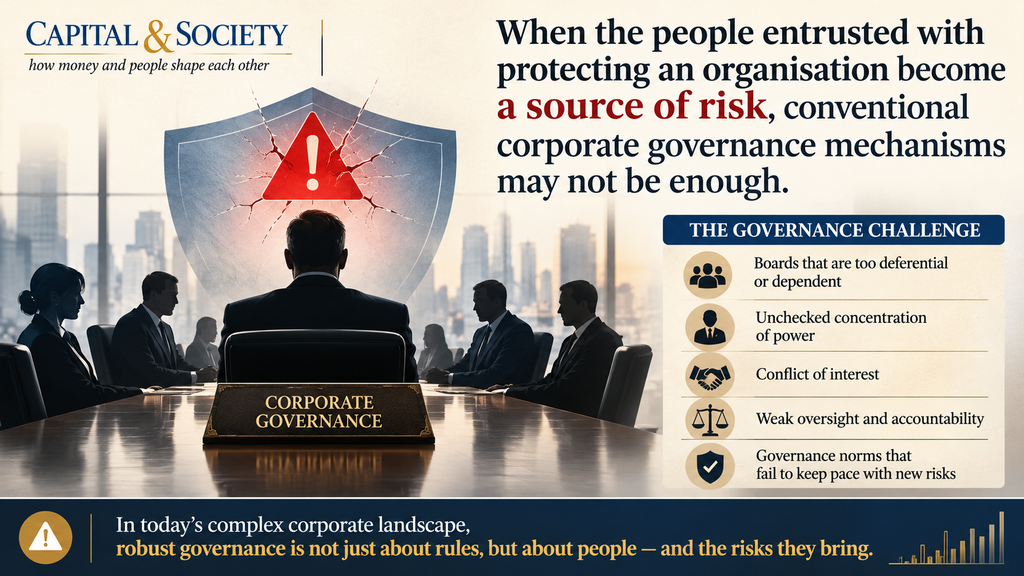
When the people entrusted with protecting an organisation become a source of risk, conventional corporate governance mechanisms may not be enough
Companies and their boards have a clear responsibility to identify business risks and take effective measures to mitigate them. Yet there are growing instances in India and elsewhere of individuals within corporate leadership or on boards posing challenges to the organisations they are expected to safeguard. What can a company do when an otherwise successful CEO is found to have engaged in misconduct? What happens when a promoter fails to put an effective succession plan in place? Or when an independent director becomes a source of conflict within the boardroom?
Conventional corporate governance frameworks are not necessarily designed to recognise or correct the misconduct of the very people who are supposed to uphold them. Traditional governance mechanisms tend to assume that a company with an independent and competent board, clearly defined roles and responsibilities, risk management and internal control systems, audit and nomination committees, disclosure mechanisms and adequate checks and balances, is reasonably protected against managerial excesses and poor decision-making.
But this assumption overlooks a fundamental aspect of corporate governance: CXOs and board members are human beings, not perfectly rational decision-making machines. Overconfidence, groupthink, confirmation bias, hubris, loss aversion and a fading ethical compass are behavioural weaknesses that can materially influence corporate decision-making. Sustained success can sometimes reinforce these biases rather than temper them.
The problem is that most governance mechanisms are designed to address failures in processes, systems and controls. They are not necessarily equipped to deal with situations in which the judgement, conduct or personal interests of the very individuals entrusted with enforcing these mechanisms become questionable. A board may have all the requisite committees and checks and balances, but their effectiveness ultimately depends on the independence, integrity and judgement of the people who constitute and operate them.
In other words, governance risks do not always originate outside the boardroom. Sometimes they emerge from within it.
So how can companies assess and manage such risks? Boardroom risks cannot be entirely eliminated given that they arise partly from human behaviour, competing interests and power dynamics. But they can be anticipated, contained and mitigated through a combination of institutional safeguards and behavioral checks.
Companies need periodic assessments of board effectiveness that go beyond regulatory compliance to evaluate behavioral risks and the quality of decision-making. These should not be theoretical exercises but should have practical implications for how boards function. Robust mechanisms are also needed to manage conflicts of interest and protect directors’ ability to dissent without fear of reprisal.
The objective of good governance is not to eliminate disagreements, individual discretion or entrepreneurial risk-taking. It is to ensure that none of these overrides the interests of the organisation.
Four experts from India Inc – the founder of an established FMCG company, a veteran chartered accountant advising companies and promoter families, a bureaucrat-turned-independent director, and a noted securities lawyer – examine where conventional governance mechanisms fall short and what companies can do when their own boardrooms become a source of risk.
Subscribe now to read further!
An extremely relevant article in context of much that is happening in Board rooms. Each constituent – the Founder, the CEO, the IDs all are areas that can impact cohesive Board functioning. Their judicious judgement is critical for the Company and stakeholders.
I fully agree mam.
Even at board level, three cultural forces are subtly at play. The organisation’s lived culture, the culture the board wishes to project to employees and the market, and the cultural backgrounds and values individual directors bring to the table.
It is often at the intersection of all three that decisions are shaped.
The deeper challenge, therefore, is trustworthiness. A commitment to the organisation’s interests above unquestioning loyalty to any individual or group, while keeping that loyalty going as well. It is a tight rope walk.
Processes and procedures matter, but they cannot substitute for the integrity and independent judgement of those entrusted to uphold them.